
Enterprise intelligence framework

Built under uncertainty.
Designed across domains.

LUMA Quant is an enterprise-grade adaptive intelligence framework for pattern recognition and regime detection when usable information is scarce, signals are unstable and uncertainty dominates. Its first public reference implementation places the framework inside a deliberately unforgiving stochastic benchmark so users can observe how it behaves when predictive shortcuts are unavailable.

P0–P2Implemented enterprise, analytical and data foundation
P3Tokenization and Web3 utility in active development
2027Market-intelligence translation and additional stochastic benchmarks
Research horizonCross-domain intelligence, medical research and information mapping
Public proof of concept

Pattern recognition with nowhere to hide.

The current EuroMillions application is deliberately positioned as a severe validation environment, not as the identity of the company. Its outcome history is observable, privileged information is minimal and deterministic certainty is not credible. That forces the framework to expose how it handles uncertainty, disagreement, candidate regime shifts, negative evidence and post-outcome failure analysis.

Users can explore the SaaS as a live test surface and inspect how the model structures evidence under these conditions. The benchmark does not make random events deterministic; it makes analytical behaviour measurable.

Minimal informational advantageNo private feature feed or hidden causal shortcut.
Observable evaluationEach released outcome can be compared with prior analytical states.
Transfer disciplineOnly behaviours that remain robust should move into new domains.
Foundation to utility

Development roadmap

P0 through P2 document implemented foundations. P3 is the current Web3 workstream. Future domains remain clearly separated from completed product claims.

P0Completed

Enterprise Product Foundation

The technical base for an operational SaaS and independently deployable services.

  • Frontend and backend service boundaries
  • Authentication, user access and delivery
  • Operational observability and deployment architecture
P1Completed

Applied Intelligence & Public Benchmark

An operational multi-axis workflow for pattern recognition and candidate regime detection under extreme uncertainty.

  • Independent analytical perspectives
  • Transition, persistence and disagreement tracking
  • Public EuroMillions proof-of-concept SaaS
P2Completed

Enterprise Data & ENMF Network

A semantic memory and data platform that connects research evidence without exposing proprietary execution logic.

  • BigQuery semantic memory graph
  • ETL, lineage and forecast-safe separation
  • AI integration and structured delivery layers
P3In progress

Tokenization & Web3 Utility

A separately disclosed on-chain layer designed to extend access and participation without replacing the SaaS credit system.

  • Utility-token infrastructure
  • Worker and platform integration
  • Transparent milestones, entitlements and boundaries
Cross-cutting workstream · Operational v1.0

Trust & Verification

Trust Layer v1.0 applies across the implemented foundation and current Web3 workstream. It publishes bounded repositories, exact source bindings, CI evidence and explicit limits without exposing the proprietary production engine.

PublishedSix bounded components plus the central Master Index.
Verified stateApplicable CI, manifests, secret scans and CodeQL checks.
Open boundariesLegal review and independent audit remain explicitly incomplete.
Planned · 2027

Enterprise & Corporate Scaling

LUMA Quant plans to continue scaling its technical and operational infrastructure and to evaluate the transition from Luma Quant e.U. to an appropriate Austrian corporate structure, such as a FlexCo or GmbH.

The objective is to strengthen governance, enterprise delivery, future team growth and international B2B partnerships. Corporate development will be aligned with the legal, tax and regulatory requirements applicable to each expanding product domain.

Infrastructure & operationsScale delivery capacity, resilience and operational governance.
Corporate structureEvaluate a future FlexCo or GmbH while Luma Quant e.U. remains the current legal entity.
Enterprise partnershipsPrepare the platform for international B2B delivery and responsible team growth.
Implemented foundation

Enterprise architecture

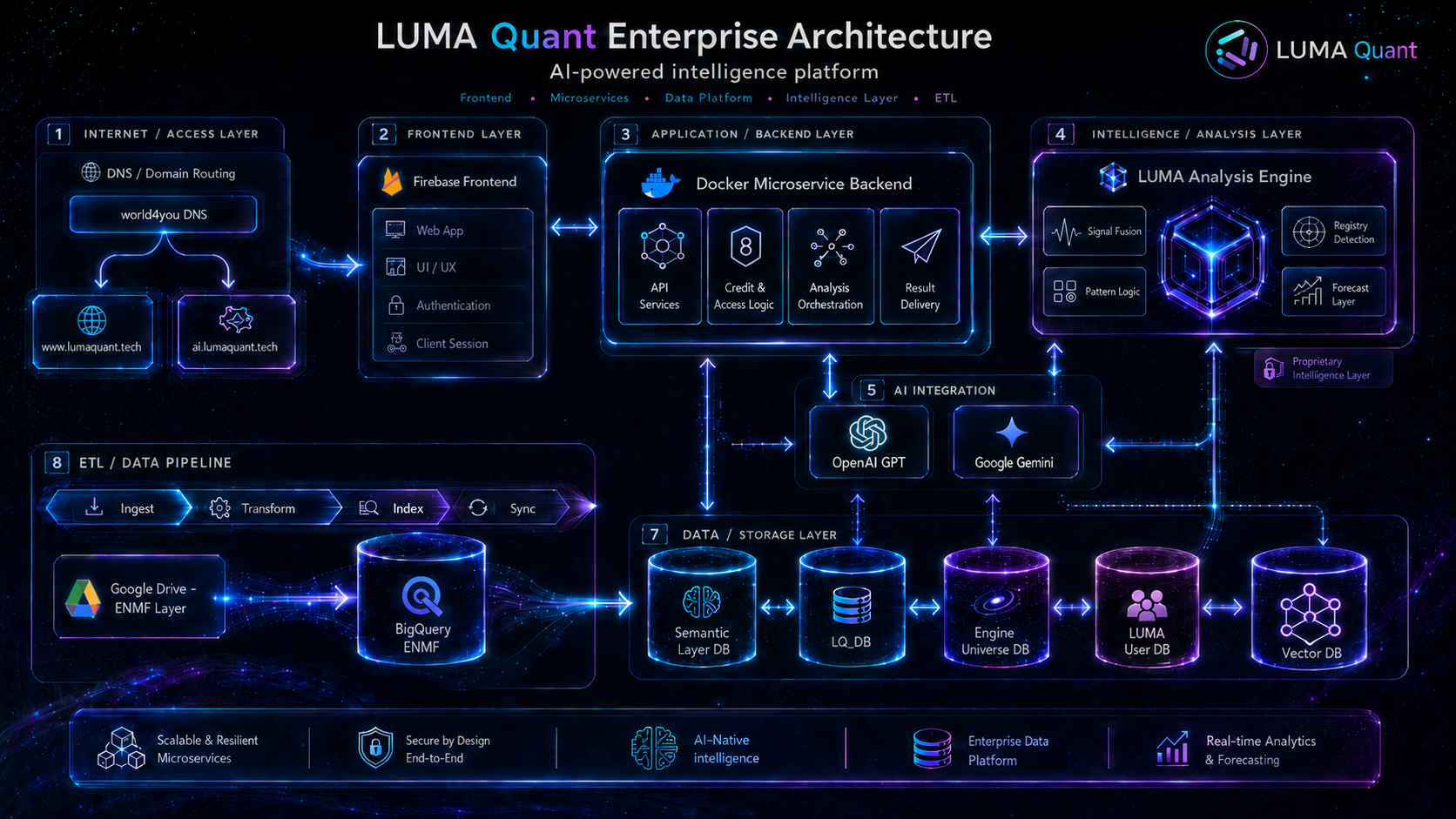
The first SaaS implementation already spans access, frontend, microservices, AI integration, data storage, ETL and a proprietary analysis layer.

Public LUMA Quant enterprise architecture showing access, frontend, microservices, analysis, AI, ETL and data layers
Public architecture view. Proprietary scoring, thresholds and execution details remain intentionally abstracted.Click to open full size
Semantic memory architecture

Selected ENMF layers

The ENMF construct organizes evidence as interacting semantic memory layers in BigQuery. The public view reveals architectural roles—not formulas, weights or decision thresholds.

01

Sensory Input

Captures source observations, provenance and raw analytical context.

02

Temporal Memory

Maintains time windows, temporal state and evolving domain context.

03

Change Memory

Records transitions, deltas and family-level structural change.

04

Interaction Memory

Maps conflicts, rebounds and relationships across analytical axes.

05

Negative-Space Memory

Preserves failure evidence, exclusions and structures that did not persist.

06

Number Landscape

Represents entity-level structure and local context in the current stochastic implementation.

07

Ranking Memory

Tracks candidate ordering and agreement across independent evidence sources.

08

Decision Memory

Stores gates, portfolio decisions and reproducible decision snapshots.

09

Post-Draw Learning

Implements the domain-neutral post-outcome learning role for the current benchmark.

10

Belief State

Maintains the current consolidated analytical state without claiming certainty.

Some layer names reflect the current stochastic reference implementation; their roles are designed to be rebound to new domain data contracts. Additional associations, model weights, gate logic, thresholds and execution detail remain proprietary.
2027 domain translation

From uncertainty architecture to market intelligence

LUMA does not transfer domain-specific predictions into financial markets. It transfers mechanisms for mapping relationships, detecting regime change, evaluating cross-layer risk and learning under uncertainty.

The planned market translation connects the analytical core to macroeconomic, microstructural, capital-market, semantic, news, on-chain and off-chain evidence.

Higher-order interaction mapping Multi-axis profiling Negative-space analysis ENMF market-state memory Walk-forward validation Regime detection Scenario simulation Decision gating
Explore the full market-intelligence translation
Interaction structuresCross-asset, sector and factor relationships beyond simple pairwise correlation.
Negative spaceMissing confirmation, silent divergence, liquidity gaps and absent participation.
Adaptive memoryPrior market states, transitions, failures and post-outcome learning.
Proof-driven expansion

Next domains

The framework expands only when each domain has an appropriate data contract, validation method and safety boundary.

Operational reference implementation

Extreme-Uncertainty Benchmark

The current EuroMillions interface lets users inspect how LUMA organizes evidence, disagreement and candidate regime changes where predictive shortcuts are weakest.

  • Fully observable outcome history
  • Minimal privileged information
  • Measured post-outcome evaluation
2027 product expansion

Additional Stochastic Benchmarks

US Powerball and Mega Millions provide independent rule systems for cross-environment validation and broader public analytics.

  • US Powerball analytics
  • Mega Millions analytics
  • Shared framework, separate validation
2027 framework transfer

Digital Asset Regime Intelligence

The framework is planned to transfer into coin and crypto-market analysis without promising trading outcomes.

  • Macro, micro and capital-market factors
  • Semantic context and news intelligence
  • On-chain and off-chain data
Explore Market Intelligence
Research horizon

Medical & Information Mapping

Later research applications for complex information systems, anomaly mapping and carefully bounded health-data exploration.

  • Domain-specific safeguards
  • Information topology and early-warning structures
  • No diagnostic claims
Open research

Privacy-Safe Synthetic Telemetry Graphs

A public Kaggle dataset supports reproducible experimentation with synthetic stochastic telemetry while keeping operational product data and proprietary research separate.

Community & Web3

Community Lab

Token utility, transparent milestones and future participation channels are documented separately from the analytical SaaS. The official LUMA Quant Discord provides a moderated space for product updates, research discussion and community participation.

Research boundary: LUMA Quant evaluates pattern persistence, structural change and disagreement under uncertainty. It does not claim deterministic prediction, guaranteed outcomes, guaranteed trading performance or medical diagnosis.